Thursday, December 08, 2022

Revivalism at Baptist Temple

Jesse Yelvington baptizing one of
51 new believers following a 1937
revival meeting at Baptist Temple.
Three distinct eras stand out in the history of Baptist Temple. These periods of time reflect what God was doing in the American church across denominational lines. They are marked by specific related activities that dominated the conversations, filled the calendars, and attracted material resources.

The first and longest of these periods of time was the Revivalism Era. The group that became Baptist Temple began as a Bible study meeting in a home but exploded in growth with tent revivals led by San Antonio City Missionary and Evangelist Doc Pegues. One or two week tent revivals were a popular and effective way of communicating the gospel in America at the start of the 20th Century and the Baptist General Convention of Texas sent evangelists around the state to start new churches.

As Baptist Temple became an established church, it would host two-week revivals in the Spring and Fall, featuring evangelists who would preach lively sermons with emotional appeal. At the end people would be pressed for a public decision to follow Christ and be baptized. Many decisions were first time conversions and others were re-dedications. During the summer, Baptist Temple would often participate in city-wide crusades preached by an evangelist with national and, even, international fame. These included Gipsy Smith and Billy Graham. Many church members would not only enthusiastically support their own revivals but would, often, attend revivals in neighboring churches.

Four out of the first nine pastors of Baptist Temple were discovered while preaching a revival. Clive L. Skinner had recently preached a two-week revival at Baptist Temple that led to 41 baptism and his calling as their pastor. Pastors Albert Beddoe and Jesse Yelvington both left Baptist Temple to pursue full-time evangelism.

Revivals required a lot of work and preparation. Deacons were charged with selecting the evangelist and arranging for his room and board. They would vote on a long list of potential preachers. Before the revival, lists of prospects would be put together and visits were made. Advertising and posters played a big role but word of mouth and personal invitations were the keys to filling the auditorium. An offering would be taken each night and given to the preacher and his team.

Follow up was equally vital to the long-term impact of the revival. The deacons divided San Antonio onto four areas. Deacons living in those areas would visit those who had made decisions to enroll them in Sunday School and schedule their baptism.

Sunday school was the foundation for both the start and the phenomenal growth of Baptist Temple and Baptist churches in general. It was the primary disciple-making ministry of the church. It is where new believers were strengthened in their faith and future leaders were discovered.

Pastor Vernon Elmore marked the end of the Revival Era. He was a popular and effective evangelist to whom the church had granted four weeks off to preach revivals in other places. This was on top of vacation and convention time. By the end of his tenure revivals had gone from two weeks to one week, to a few days; from twice a year to once, to sporadic scheduling. Revivals would be replaced by event evangelism. Block parties (like Baptist Temple's Fall Festival) would become the new normal. Guest evangelists would be replaced by Christian musical groups and Sunday morning celebrity testimonies.

Block parties, Christian concerts, and Vacation Bible School are what remain of the 57 year Revivalism Era at Baptist Temple (1906-1963).

Thursday, December 01, 2022

Life in the Baptist Temple Office

Guest Blog by Muriel Persky

Mary Lee Shelton

Mary Lee Shelton began working full time at Baptist Temple Church in 1976 as Education Secretary to D. Ray Taylor, Minister of Education. O.D. Oliver was the Pastor. Her job was to keep the records of the Sunday School and Training Union memberships, and other secretarial duties. At that time the Sunday School membership was over 500 and all the offering envelopes needed to be counted before worship time each Sunday. The numbers were posted for the Church to view.

She was accepted right away by the other office staff. Kathryn O’Diem was the office manager, Jo Lynn was bookkeeper, and Louise Dudley was the pastor’s secretary. Each lady had responsibilities and a very busy schedule. The routine included weekly, never ending deadlines: Temple Times,Southside Reporter articles, bulletins, record keeping and more. At that time records were kept manually and typewriters were used for the printed articles. Mary Lee helped keep the financial giving records for each member; each entry done manually.

The office door was always open and visitors were welcome to visit and chat. Weekdays were busy with many meetings and church members engaged in variety of tasks, including the daycare, an active WMU program, the Seniors' Ministry, and TOUCH.

In 1979, Jo Lynn retired and Louise Dudley stepped into the bookkeeper position and Mary Lee became the pastor’s secretary. When Bill Perdue replaced Oliver as pastor, she continued as secretary. Her primary job was to answer the pastor's phone and type his sermons. The sermons were dictated into a machine (Dictaphone) and transcribed. Mary Lee also created an outline of the sermon. An extra touch appreciated by Purdue. She also typed Perdue's weekly column for the Southside Reporter weekly for publication.

Mary Lee was kept busy by three Together We Build capital campaigns that requires many mail-outs, meetings, program planning, and a big kick-off at the San Antonio Convention Center Auditorium. There was much hubbub during those years of building renovations. New offices were built and records moved. Moreover, the office staff had to adapt to the emerging computer age. Still, all ran smoothly among the office staff.

One of her fondest memories were the years of working with Philip and Mary Ann Stephens. Phillip came to the church in 1981 as Minister of Music. Mary Ann, not yet part of the staff, volunteered to produce a Christmas dinner theater presentation as a fund raiser for the Lottie Moon Christmas Offering. A musical of Lottie Moon’s life was presented for two nights.. The WMU took over the dinner planning, menus and decor. The office staff pitched in by making the playbills, copying materials for the cast, and aiding in whatever way needed. It was a wonderful celebration and dinner theater would be repeated each year for some time with different plays presented.

In 1991, Pipe Creek Retreat Center was given to the church and Mary Lee spent much of her time promoting the center to individuals and other churches while continuing her duties as pastor’s secretary and recording financial records of the membership.

In 1995, Mark Newton became our pastor and brought a new agenda for the church which included community ministry. Two Habitat for Humanity homes were built and other programs were started.

In 2001, she retired just shy of 25 years of service. Mary Lee's first job, as a teen, was working in the BT office. She worked 4 hrs a day at .65 cents an hour until she graduated from Brackenridge High School in 1956 and went to college. She started working at Baptist Temple and ended her career at Baptist Temple.

Monday, March 07, 2022

Set apart and prepared for ministry


 By faith
Moses’ parents hid him
for three months
after he was born,
because they saw
he was no ordinary child,
and they were not afraid
of the king’s edict.
Hebrews 11:23


Moses' ministry preparation had been put in motion centuries before his birth. His ancestor Joseph had been sold into slavery in Egypt by his brothers. God provided opportunities for him to rise through the ranks until he became second only to Pharaoh and administered Egypt's food distribution program. (Genesis 39-47)

A worldwide famine caused Joseph's father and his entire clan to emigrate to Egypt, where they were welcomed by Joseph and Pharaoh. He told his brothers, “As for you, you meant evil against me, but God meant it for good, to bring it about that many people should be kept alive, as they are today” (Genesis 50:20.)

The Hebrews (Joseph's people) prospered and grew in number, while maintaining their language, culture and religion. A change in government led to the Hebrews becoming slaves. Their continued growth led Pharaoh to order the death of all male children at birth. When the midwives did not comply with his decree, Pharaoh ordered all male babies to be drowned.

“By faith Moses’ parents hid him for three months after he was born, because they saw he was no ordinary child, and they were not afraid of the king’s edict” (Hebrews 11:23.)

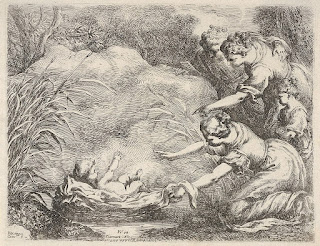
Then, they placed Moses in an ark and floated him down the river where Pharaoh’s daughter rescued him. Knowing the child to be a Hebrew, she ignored Pharaoh's decree and adopted him. Moses' sister Miriam had secretly followed and offered to find a Hebrew wet nurse for the infant. Thus Moses’ mother was the one who nursed him. She would return the child once it was weaned but, for two or three years, Moses was nursed by his mother. She sang lullabies and told him stories that planted the seeds of faith in him. Paul reminded Timothy that his faith was first kindled by his mother and grandmother (2 Timothy 1:5.) The Bible tells us, “Train up a child in the way he should go and when he is old he will not depart from it (Proverbs 22:6.)

Following his early education in the faith at his mother's knee, “Moses was educated in all the wisdom of the Egyptians and was powerful in speech and action” (Acts 7:22.)

God had plans for Moses to lead, govern and give laws to a nation. Towards that end, the first 40 years of his life were spent in the courts of Pharaoh but the Bible tells us, “By faith Moses, when he had grown up, refused to be known as the son of Pharaoh’s daughter” (Hebrews 11:24.)

Moses thought he could help his people by his own power, prestige, and position but God had another plan. Moses murdered an Egyptian who was beating a Hebrew slave and had to flee to the desert. This brought about the next phase of Moses education.

In the desert, Moses became accustomed to hardship and poverty, learning how to live in want as well as how to live with plenty. Those whom God intends to exalt he will make humble first (1 Peter 5:6.)

His life in Egypt made him as a scholar, a gentleman, a statesman, and a soldier. Moses now learned about quiet deliberation and patience. He would come to know what its like to live close to God through the solitude of a shepherd’s life.

Moses needed to learn that it would be God who would deliver the Hebrews. God did not need Moses' military powers. He had to be weak and humble enough for God to use.

God is in control. He chose the date and place of your birth according with the mission he desires for you to accomplish. God uses the experiences of your life to prepare you for the challenges ahead. His timing is perfect.

Regardless of who you are or where you have been God desires to do great things through you. It can be difficult to understand or see the role that God has called you to but, if you remain faithful, it will eventually become clear.

Our past does not disqualify us from God’s service. There are no wasted experiences. God will take our past mistakes and use them to prepare us for what He intends to accomplish through us. God give us the ability to rise above our past and to accomplish great things for Him.

There is not a minute when God is not present. He is present in the birth of Moses. He is present in his Mother and sister and the woman who rescued him from the water.

Moses' biography reminds us that even in the darkest of times, God has a plan. The Hebrews were slaves under a cruel and corrupt leader at the time of the birth of Moses. At the darkest moment, God was already at work. God has a plan for you. God has a plan for His church. God has a plan for your community. No matter how dark the days or how confusing the world is, God has a plan. 


For we are His creation,
created in Christ Jesus for good works,
which God prepared ahead of time
so that we should walk in them
.
Ephesians 2:10