Showing posts with label Exodus. Show all posts

Sunday, April 05, 2026

From Chaos to Living Water

Water is a big deal in San Antonio. The local news focuses on our rain chances and the water level in the Edwards Aquifer. It’s a big deal in the Bible, too. From Genesis to Revelation, water flows both as a physical necessity and a theological thread—an image of creation, judgment, deliverance, renewal, and life itself.

The Bible begins with water. In Genesis 1:2, “the Spirit of God was hovering over the face of the waters.” Before land was formed, before vegetation or living creatures appeared, there was water—formless, deep, and mysterious. God brought order to these waters. It is both life-giving and, when unrestrained, capable of overwhelming destruction, as later seen in the flood narrative of Genesis 6–9.

Water’s dual nature—life-giving and destructive—sets the stage for its role in redemption. We see it displayed in the parting of the Red Sea. The Hebrews are trapped between Pharaoh’s army and the sea. What appears as certain death becomes the means of salvation. God parts the waters, creating a path of deliverance for His people while the same waters collapse upon the pursuing Egyptians. Water becomes both judgment and salvation. For Israel, it is a passage into freedom; for Egypt, it is an instrument of destruction. 

The New Testament deepens this imagery. In 1 Corinthians 10, Paul describes Israel’s passage through the sea as being “baptized into Moses in the cloud and in the sea.” A transition into a new identity. This concept finds fuller expression in baptism, as described in Romans 6:4, believers are “buried with Him by baptism into death, in order that…we too might walk in newness of life.” Through water, the believer symbolically dies to the old life and rises to new life in Christ. Baptism is a reenactment of deliverance, a visible sign of an inward transformation.

The birth of Jesus involved the breaking of water—the amniotic fluid that signals the arrival of new life. The One who created the waters of Genesis was Himself born through the waters of childbirth. Creation and incarnation meet. The Creator steps into creation, embracing its physical realities to redeem them. 

In John 4, Jesus offers a Samaritan woman water that will become “a spring of water welling up to eternal life.” Unlike physical water, which temporarily satisfies thirst, this living water represents the enduring, life-giving presence of God through the Holy Spirit. Later, in John 7:37–38, Jesus proclaims, “If anyone thirsts, let him come to me and drink…out of his heart will flow rivers of living water.” Water becomes a source of continual spiritual vitality.

The theme reaches its climax in Revelation 22:1: “the river of the water of life, bright as crystal, flowing from the throne of God and of the Lamb.” This final image brings the biblical narrative full circle. The waters that once covered the formless earth now flow in perfect clarity and purpose, nourishing the tree of life and sustaining the renewed creation. The invitation that follows— “Let the one who is thirsty come; let the one who desires take the water of life without price” (Revelation 22:17)—echoes the offer of living water made by Jesus.

What the Bible presents theologically, San Antonio experiences physically: a world where water is both a gift of God and a reminder of human dependence. The city was founded where water could be found. Yet, as in Genesis, the waters must be managed and respected. When rainfall declines, the illusion of abundance disappears. Water is not guaranteed—it is given.

In our drought-prone region, this symbolism carries added weight. “Living water” speaks directly into lived experience. Physical water can fail, systems falter, and supplies diminish, but the water Christ offers is not subject to drought. It is not dependent on rainfall or geography. It flows from a different source. The dryness of the land is a reminder that human life is dependent, not self-sustaining. Just as the body thirsts for water, the soul thirsts for something more enduring.

The same God who brought order to the waters, parted the sea, and offered living water remains the source of life today. Life is sustained not by what we control, but by what we receive. The deeper promise remains unchanged: the source of life does not run dry and satisfies the deepest thirst of the human soul. 

Monday, March 07, 2022

Set apart and prepared for ministry


 By faith
Moses’ parents hid him
for three months
after he was born,
because they saw
he was no ordinary child,
and they were not afraid
of the king’s edict.
Hebrews 11:23


Moses' ministry preparation had been put in motion centuries before his birth. His ancestor Joseph had been sold into slavery in Egypt by his brothers. God provided opportunities for him to rise through the ranks until he became second only to Pharaoh and administered Egypt's food distribution program. (Genesis 39-47)

A worldwide famine caused Joseph's father and his entire clan to emigrate to Egypt, where they were welcomed by Joseph and Pharaoh. He told his brothers, “As for you, you meant evil against me, but God meant it for good, to bring it about that many people should be kept alive, as they are today” (Genesis 50:20.)

The Hebrews (Joseph's people) prospered and grew in number, while maintaining their language, culture and religion. A change in government led to the Hebrews becoming slaves. Their continued growth led Pharaoh to order the death of all male children at birth. When the midwives did not comply with his decree, Pharaoh ordered all male babies to be drowned.

“By faith Moses’ parents hid him for three months after he was born, because they saw he was no ordinary child, and they were not afraid of the king’s edict” (Hebrews 11:23.)

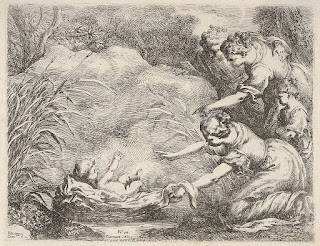
Then, they placed Moses in an ark and floated him down the river where Pharaoh’s daughter rescued him. Knowing the child to be a Hebrew, she ignored Pharaoh's decree and adopted him. Moses' sister Miriam had secretly followed and offered to find a Hebrew wet nurse for the infant. Thus Moses’ mother was the one who nursed him. She would return the child once it was weaned but, for two or three years, Moses was nursed by his mother. She sang lullabies and told him stories that planted the seeds of faith in him. Paul reminded Timothy that his faith was first kindled by his mother and grandmother (2 Timothy 1:5.) The Bible tells us, “Train up a child in the way he should go and when he is old he will not depart from it (Proverbs 22:6.)

Following his early education in the faith at his mother's knee, “Moses was educated in all the wisdom of the Egyptians and was powerful in speech and action” (Acts 7:22.)

God had plans for Moses to lead, govern and give laws to a nation. Towards that end, the first 40 years of his life were spent in the courts of Pharaoh but the Bible tells us, “By faith Moses, when he had grown up, refused to be known as the son of Pharaoh’s daughter” (Hebrews 11:24.)

Moses thought he could help his people by his own power, prestige, and position but God had another plan. Moses murdered an Egyptian who was beating a Hebrew slave and had to flee to the desert. This brought about the next phase of Moses education.

In the desert, Moses became accustomed to hardship and poverty, learning how to live in want as well as how to live with plenty. Those whom God intends to exalt he will make humble first (1 Peter 5:6.)

His life in Egypt made him as a scholar, a gentleman, a statesman, and a soldier. Moses now learned about quiet deliberation and patience. He would come to know what its like to live close to God through the solitude of a shepherd’s life.

Moses needed to learn that it would be God who would deliver the Hebrews. God did not need Moses' military powers. He had to be weak and humble enough for God to use.

God is in control. He chose the date and place of your birth according with the mission he desires for you to accomplish. God uses the experiences of your life to prepare you for the challenges ahead. His timing is perfect.

Regardless of who you are or where you have been God desires to do great things through you. It can be difficult to understand or see the role that God has called you to but, if you remain faithful, it will eventually become clear.

Our past does not disqualify us from God’s service. There are no wasted experiences. God will take our past mistakes and use them to prepare us for what He intends to accomplish through us. God give us the ability to rise above our past and to accomplish great things for Him.

There is not a minute when God is not present. He is present in the birth of Moses. He is present in his Mother and sister and the woman who rescued him from the water.

Moses' biography reminds us that even in the darkest of times, God has a plan. The Hebrews were slaves under a cruel and corrupt leader at the time of the birth of Moses. At the darkest moment, God was already at work. God has a plan for you. God has a plan for His church. God has a plan for your community. No matter how dark the days or how confusing the world is, God has a plan. 


For we are His creation,
created in Christ Jesus for good works,
which God prepared ahead of time
so that we should walk in them
.
Ephesians 2:10

Monday, February 28, 2022

Inconvenient Children


Then Pharaoh gave this order to all his people:
Every Hebrew boy that is born you must throw into the Nile,
but let every girl live.”
Exodus 1:22

Jacob and his clan moved to Egypt to escape the famine in Canaan. Over time they became enslaved by the Egyptians and were forced into labor, making bricks for Egypt's building projects. The Hebrew slaves grew in numbers to a point that Pharaoh feared an uprising (Exodus 1:10.) As a population control measure, Pharaoh ordered that all male Hebrew children be killed at birth (Exodus 1:16, 22.)

This was not the only time in the Bible when inconvenient children were destroyed. When King Herod learned that a child was born who was destined to be King of the Jews, he set out to kill him. Failing to locate the child, he ordered the slaughter of all the boys aged two and under in Bethlehem (Matthew 2:16-18.)

Moses was spared by the midwives and “By faith Moses’ parents hid him for three months after he was born, because they saw he was no ordinary child, and they were not afraid of the king’s edict (Hebrews 11:23.”) Moses was a special child, destined by God for a unique role in history but isn't every child special?

The Bible tells us that “Children are a heritage from the Lord, offspring a reward from him. Like arrows in the hands of a warrior are children born in one’s youth. Blessed is the man whose quiver is full of them (Psalm 127:3-5.”) Yet, some find children an inconvenience. From 1980-2015 China enacted a one child policy that led to forced contraception, abortions and the abandonment of baby girls.

In the infamous 1982 case of Baby Doe, a child was born with Down syndrome and a blocked esophagus. The parents refused to allow the surgery that would have corrected the blockage. They allowed their baby to starve to death. The law and the hospital let this happen. He was allowed to die because he was considered defective and inconvenient. Ultrasounds and amniocentesis are routinely used today to detect congenital anomalies. An abortion is recommended if the child does not fit the “quality of life” model of our society.

A little over 20 years ago, a woman discovered that the child she was carrying would be be born with limb anomalies. She refused an abortion and raised her son (and his brother) as a single mom. The boy required multiple surgeries and greater care than would have been typically required. He grew up to be a handsome young man; a college graduate with a career in information technology who drives customized van.

Not all stories have such a heroic plot. Children are valued because they carry the image of God, not because of what they can contribute to society. A man I met told me of his four beautiful children. They were smart, athletic and talented. He was proud of them but it was his fifth child that taught him about love. She was born with Down syndrome and would never be the things his other children were. He realized that part of his love for the older kids lay in pride and their accomplishments. The youngest he loved unconditionally. He considered her a gift from God

Jesus said, “Let the little children come to me,
and do not hinder them,
for the kingdom of heaven belongs to such as these."
Matthew 19:14